
Supporting women entrepreneurs through access to finance
One woman has gradually built her livelihood through persistence and hard work. Through access to microfinance, Ms. Umsih was able to transition from subsistence farming to a more stable, income-generating activity, illustrating how financial services can support women’s economic empowerment and household resilience.
LOOKING FOR A RELIABLE INCOME-GENERATING ACTIVITY
Born and raised in Cariu, West Java, Indonesia, Ms. Umsih, 45, completed her education up to the elementary school level. She is married and a mother of three children. For many years, she and her husband worked as rice and peanut farmers, cultivating small plots of land and depending heavily on weather conditions and market prices. The rice is harvested approximately every three months, while peanuts are harvested every two days during the growing season.
Despite their efforts, income from farming was irregular and unpredictable, often fluctuating between planting and harvest periods. This situation limited their financial stability and made it difficult to meet daily household needs consistently, prompting them to seek an alternative source of livelihood. To secure a more stable daily income, Ms. Umsih and her husband decided to pursue oyster mushroom cultivation, a product that can be harvested every day. This situation highlights the vulnerability of smallholder farmers to income volatility and the need for more stable, diversified sources of revenue.
A SEED OF POSSIBILITY
In 2010, Ms. Umsih applied for her first loan from KOMIDA, for IDR 500,000 (approximately USD 33), to support the start of her oyster mushroom cultivation business. This loan marked her first access to formal financial services and enabled her to invest in a more stable and productive livelihood. This support contributes to SDG 5 (Gender Equality) by expanding women’s access to finance and enabling women’s entrepreneurship. She chose KOMIDA because of its strong reputation and its long-standing presence in supporting small businesses in her village. KOMIDA is a microfinance institution that provides financial services to low-income communities, particularly women entrepreneurs, who often have limited access to formal banking systems.
LEARNING BY DOING, GROWING BY BELIEVING
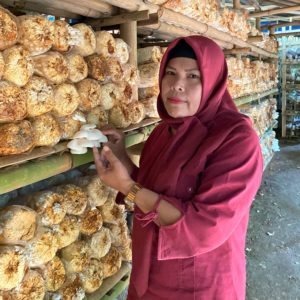
Ms. Umsih learned oyster mushroom cultivation through self-study and by exchanging experiences with others running similar businesses. Without formal training, she familiarized herself with the process of growing mushrooms in a simple, controlled environment, using locally available growing materials and managing daily maintenance to allow for regular harvests. Along with developing production skills, she also taught herself basic bookkeeping, recognizing the importance of carefully managing income and expenses.
Over time, her small venture steadily grew into a well-established business. Today, Ms. Umsih operates a 9 × 25-meter mushroom production house, where she employs five workers. The business contributes to local job creation in a rural area and produces approximately 50–80 kilograms of oyster mushrooms each day. She sells the mushrooms through two long-term collector partners, who distribute them to traditional market sellers in Jakarta and surrounding areas. With a selling price of IDR 12,000 (approximately USD 0.80) per kilogram and production costs of around IDR 4,500 (approximately USD 0.30) per kilogram, the business now provides a reliable and sustainable source of income. By producing a consistent supply of fresh mushrooms, her business contributes to local food supply chains and meets growing demand in nearby urban markets.
BUILDING A FUTURE THROUGH HER BUSINESS
Ms. Umsih’s mushroom business has grown steadily over the years, providing a reliable source of income for her household. She currently has an outstanding loan of IDR 20,000,000 (approximately USD 1,343) from KOMIDA, which she repays in weekly instalments to the field officer every Monday. The business has enabled her to support her family and invest in her children’s education. Today, all of her children have attended university, and her second daughter recently became a nurse.
LOOKING AHEAD
Ms. Umsih plans to expand her mushroom production house to increase output and revenue. Once her current loan is fully repaid, she intends to apply for a larger loan from KOMIDA to support this expansion, further strengthening her role in local food supply chains and reaching more urban markets through her long-term collector partners.
A PARTNERSHIP BUILT ON TRUST
Ms. Umsih’s journey reflects how access to financial services, combined with determination and gradual learning, can support the growth of a small rural enterprise. From an initial IDR 500,000 loan to a mushroom cultivation business generating daily income, her story illustrates steady progress built through commitment, discipline and trust between an entrepreneur and a microfinance institution.